Koddi
Client
Koddi
Year
June 2025
Role
Sole designer
Campaign planning is full of assumptions about who will see an ad, how far it will travel, and what it might deliver. Without visibility early on, strategy becomes approximation. This tool helps advertisers see the shape of an audience ahead of launch, forecasting reach and performance with more clarity.
Overview
WHERE PLANNING BREAKS DOWN
In advertising, the most important decisions are often made before anything is live. Teams choose audiences, set budgets, and commit to strategy without fully seeing what reach will look like or how performance might unfold.
Planning becomes a process of approximation, built on partial signals, uncertainty, and blind spots.
Problem space
EXISTING INTERFACE
The current experience feels less like building an audience and more like configuring a set of options.
As users move through the flow, there’s little sense of where they are or what the path ahead looks like.
Instead of a guided journey toward launch, the process becomes a series of checkboxes. Functional, but disconnected from intent.
Design process
EARLY ITERATIONS
The current experience feels less like building an audience and more like configuring a set of options.
As users move through the flow, there’s little sense of where they are or what the path ahead looks like.
Ad placement
EARLY ITERATIONS
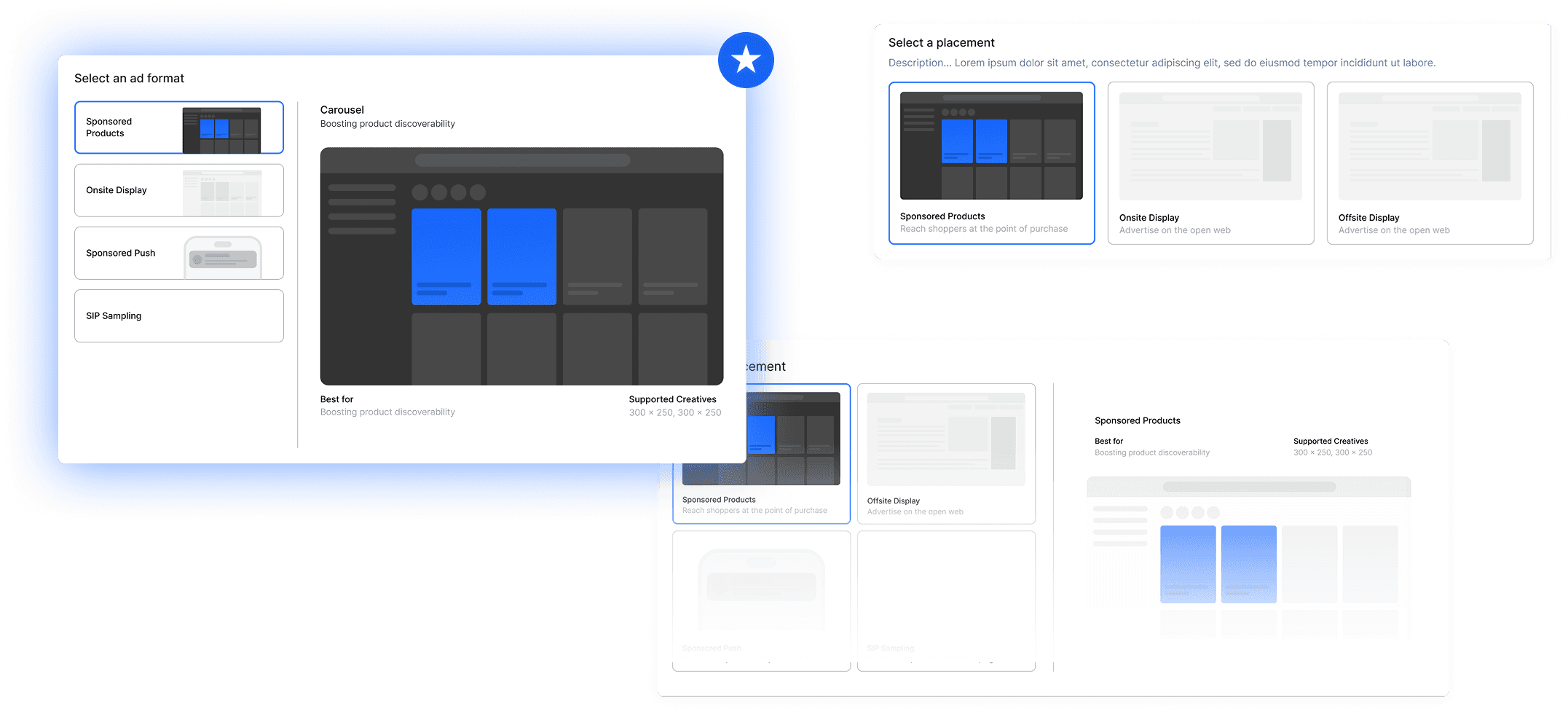
Rather than beginning with configuration, the experience should open with insight. By surfacing projected sales lift upfront, users gain immediate clarity on the impact of their choices.
Audience
EARLY ITERATIONS
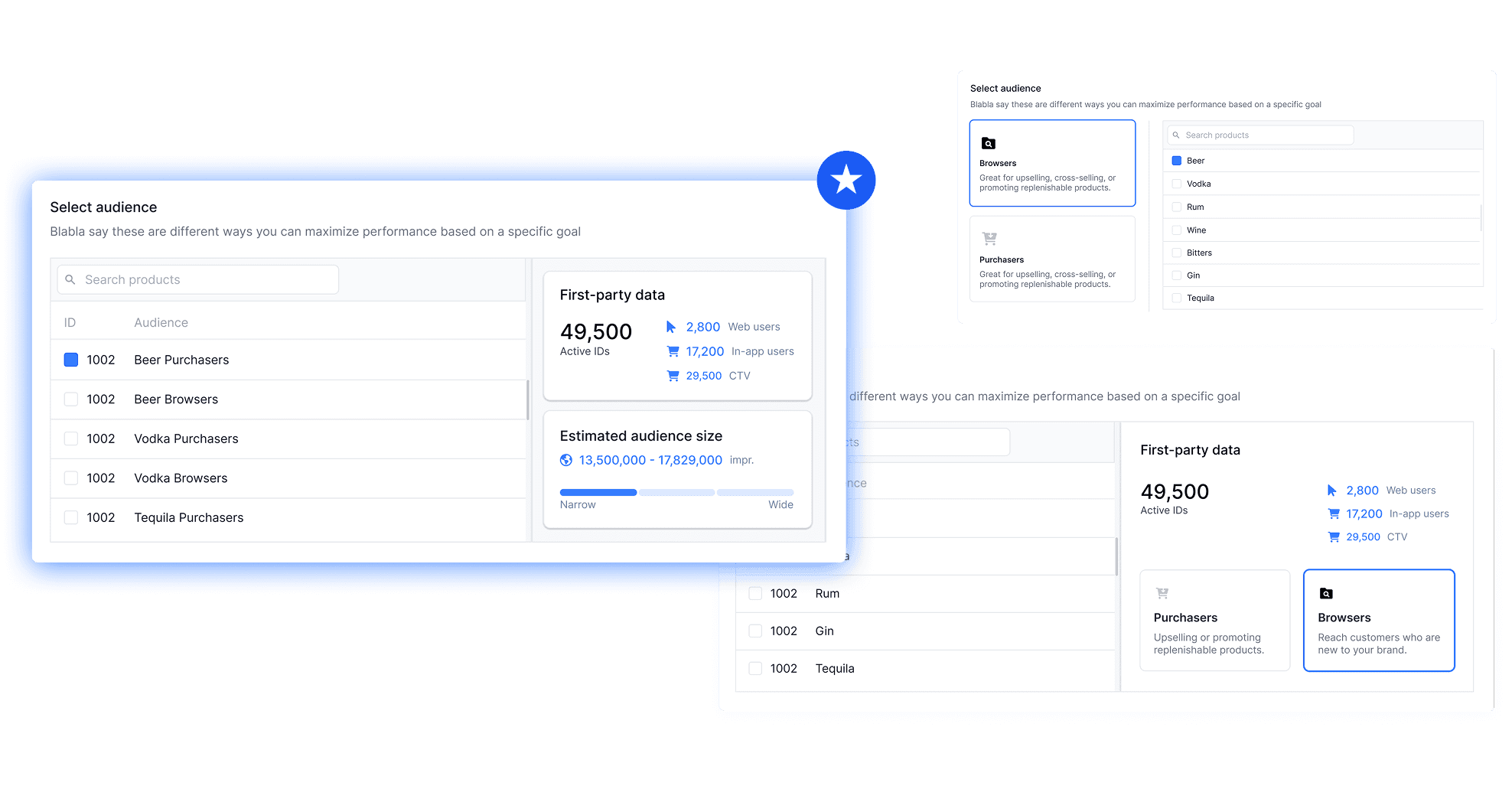
The opportunity lies in shifting insight forward. By offering an early view into projected performance, we give users clarity before commitment and remove the sense of a black box.
Building a kit
EARLY ITERATIONS
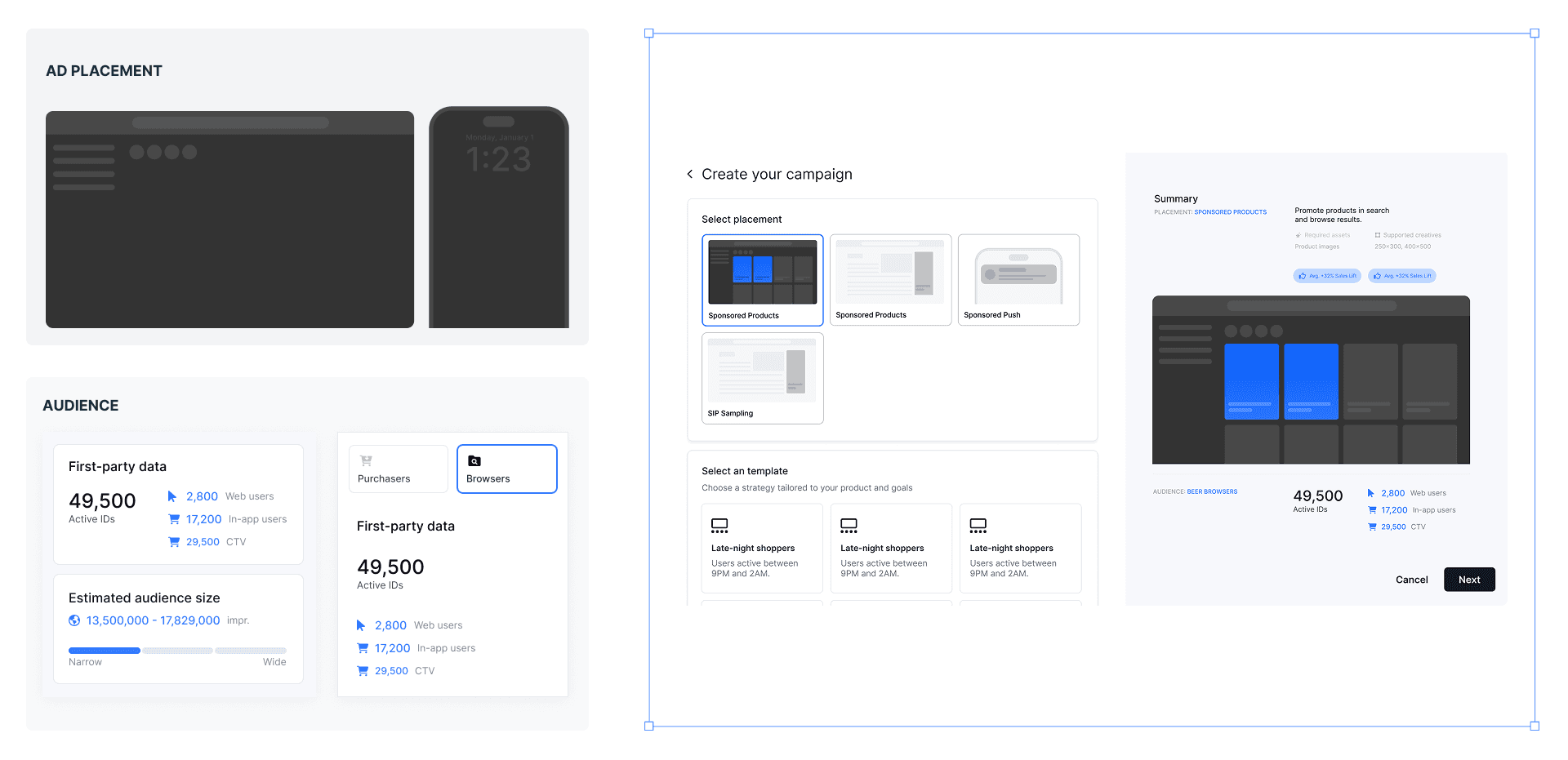
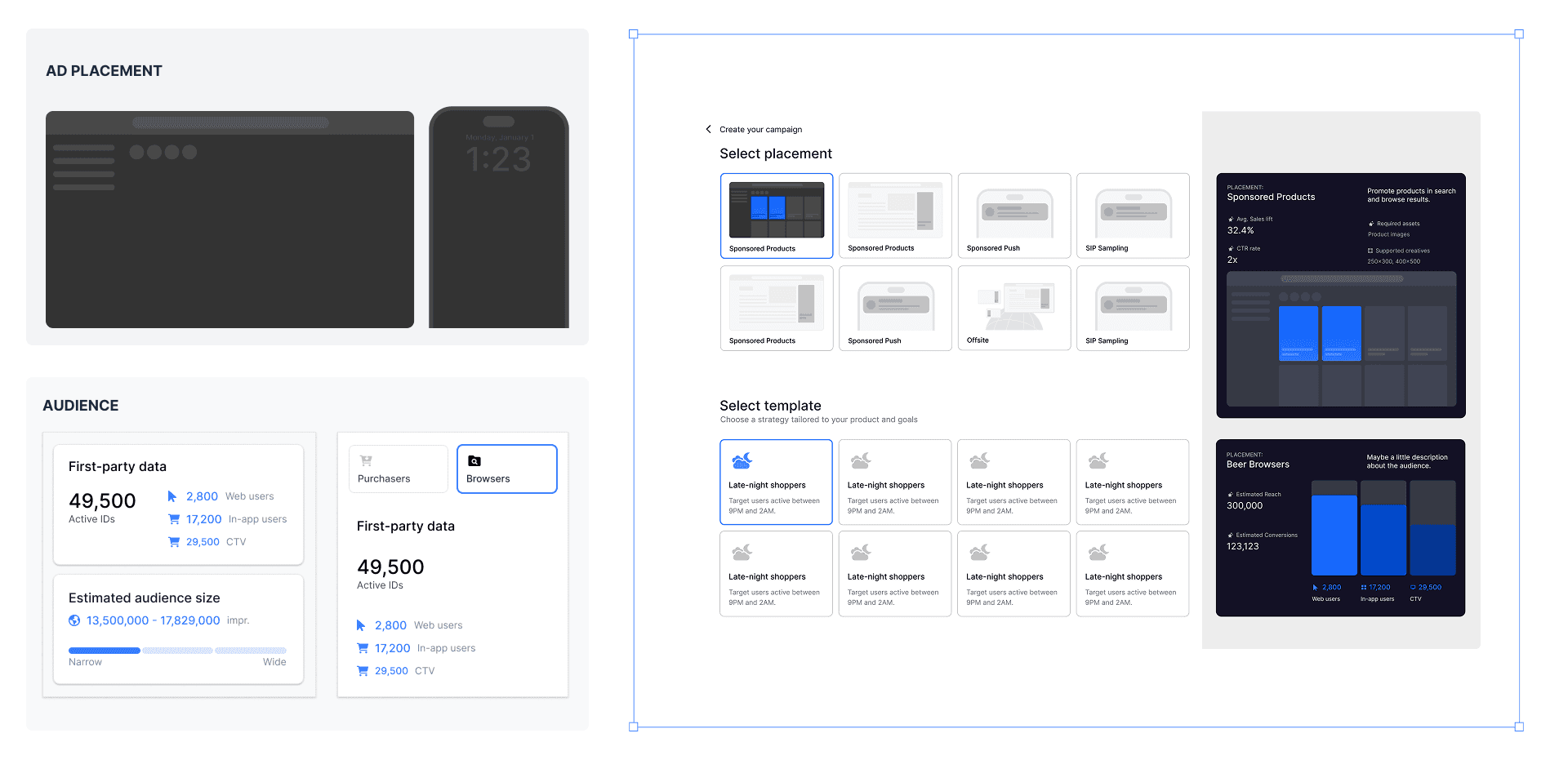
A scalable component system defines consistent patterns and hierarchy. With this foundation, information can be reconfigured across views while preserving coherence and continuity.
Building a language
EARLY ITERATIONS
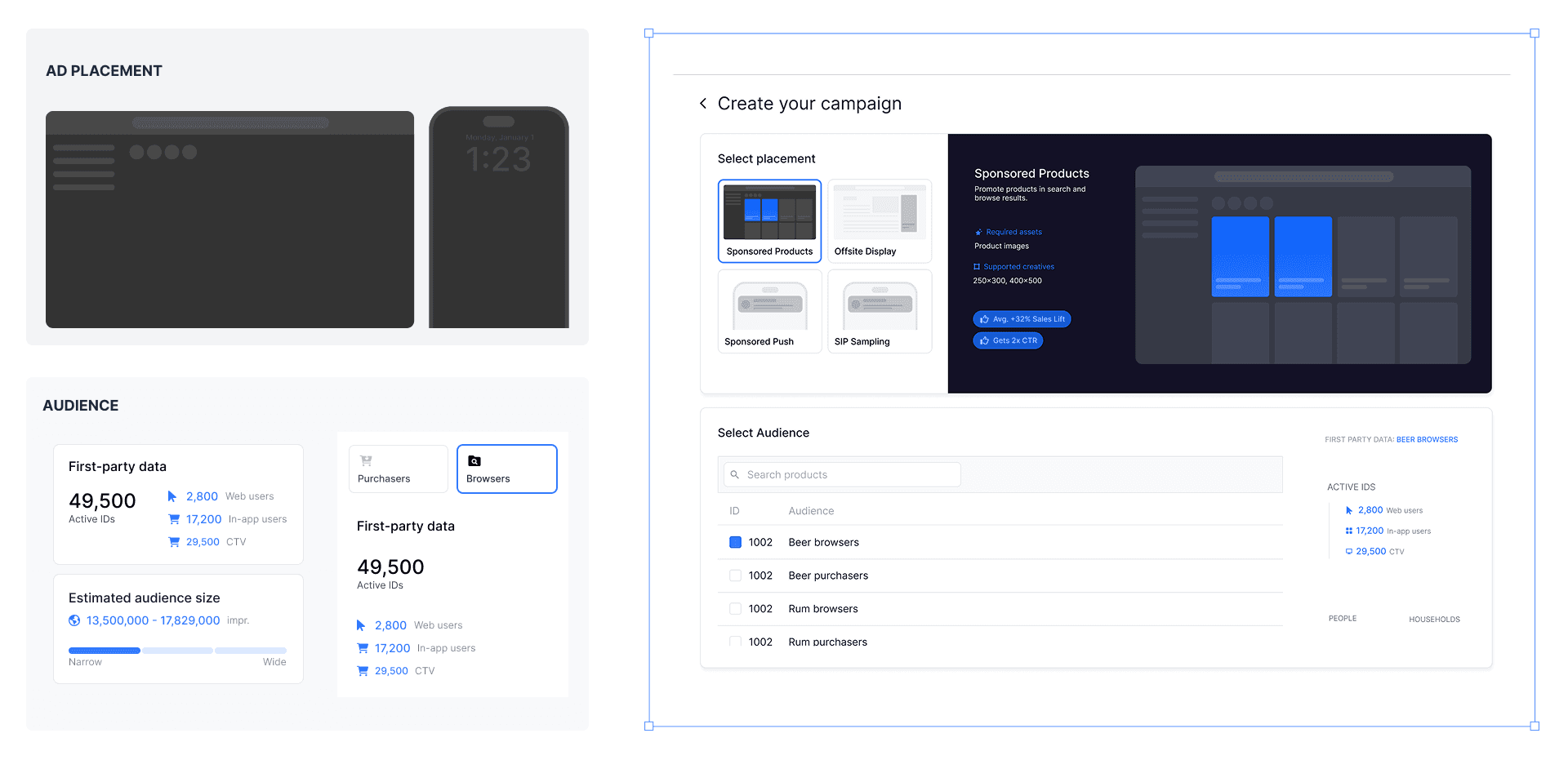
Developing components from the ground up established a scalable design language that could extend across iterations. Additional layers of definition and embedded visual feedback strengthened consistency and user orientation over time.


Solution
TYING IT ALL TOGETHER
The final solution was validated with both new and experienced users, ensuring the system could guide beginners while remaining efficient for advanced workflows.
Placements in context
SOLUTION
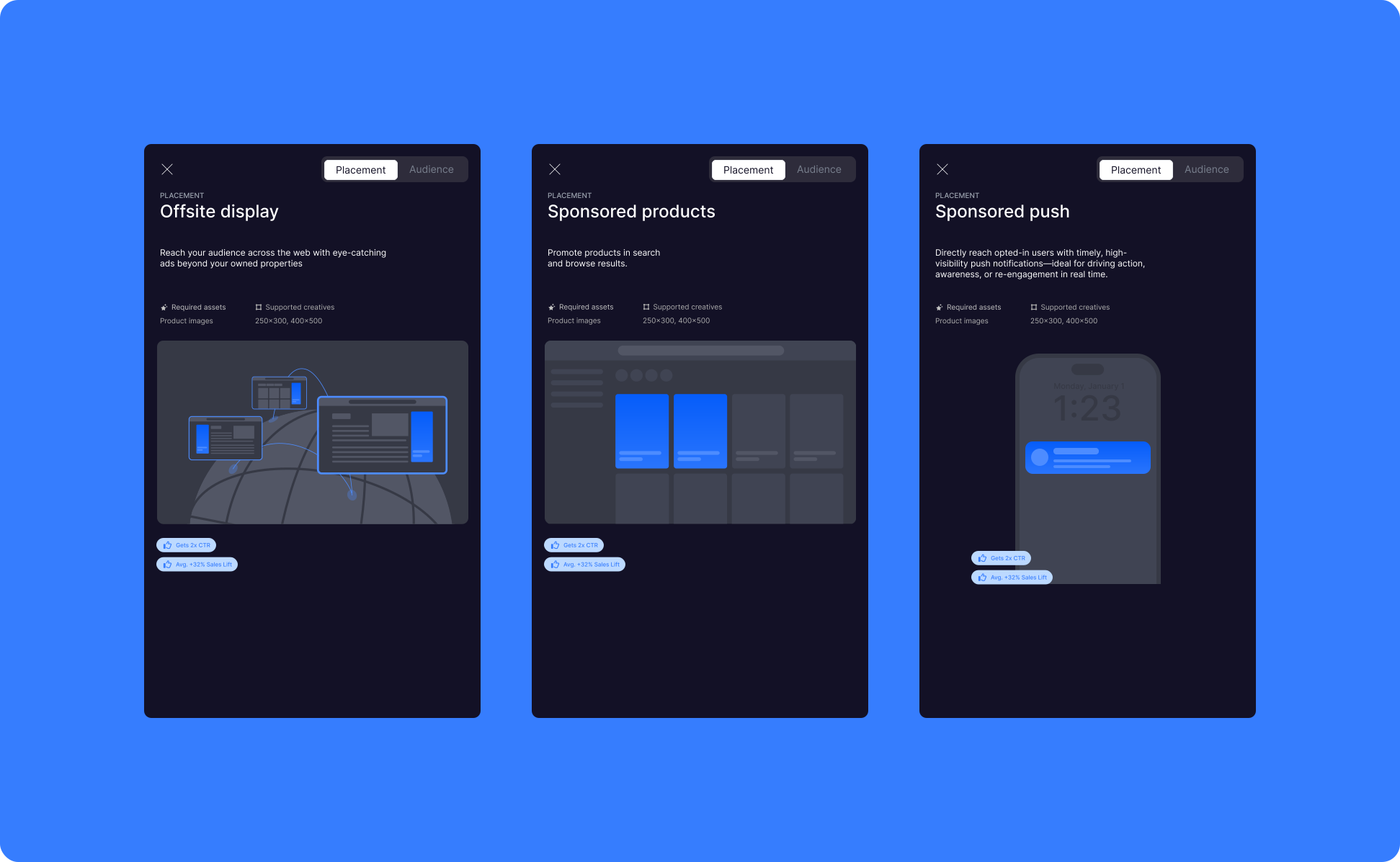
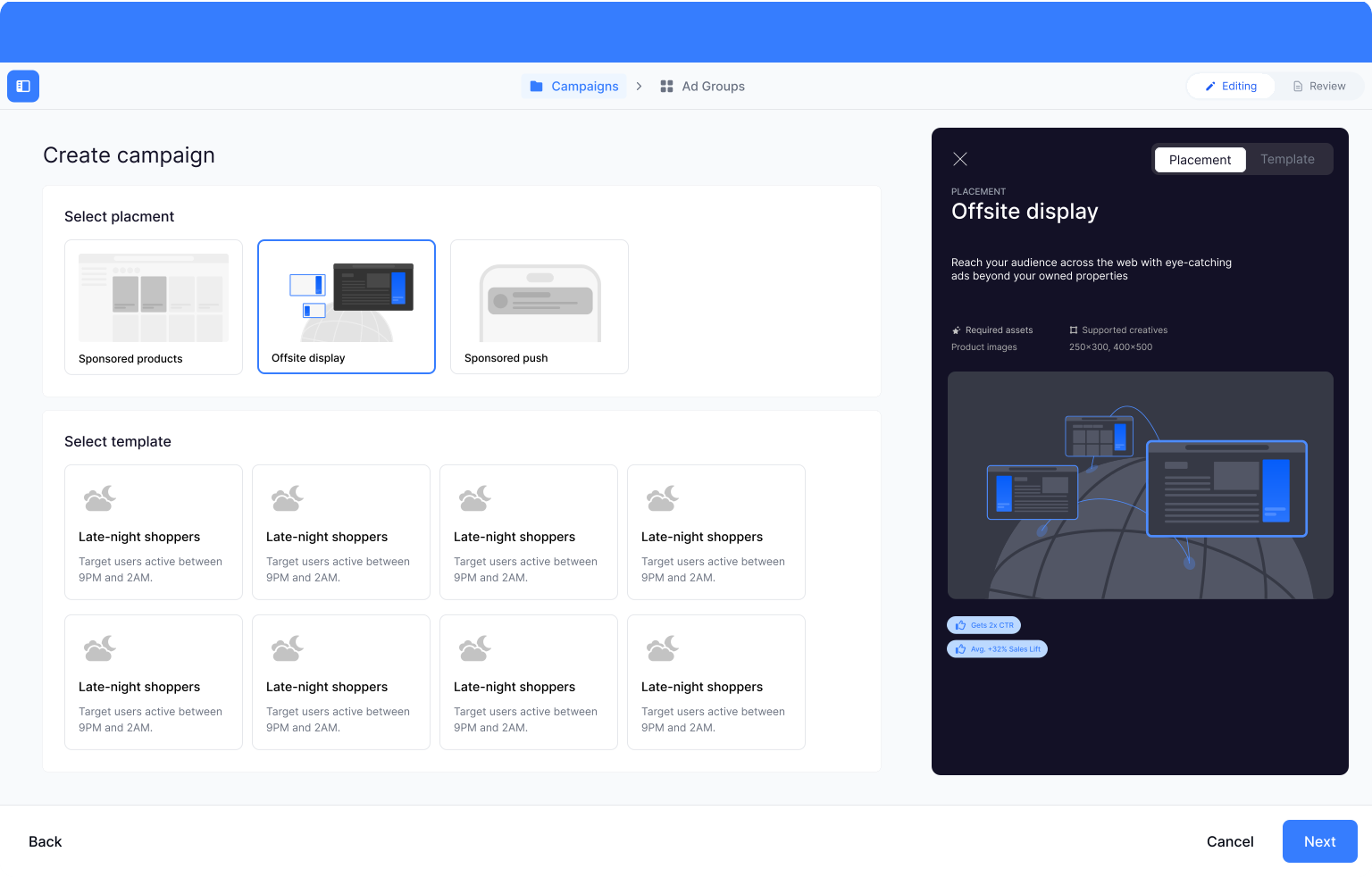
Clicking an ad placement reveals a small widget with key details. Expanding it opens an animated preview that shows how the sponsored product appears in context, helping advertisers better understand their choices and what they are building.
Clarity through Feedback
SOLUTION
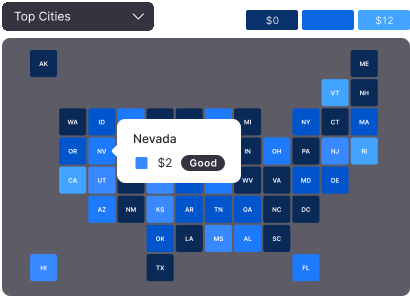
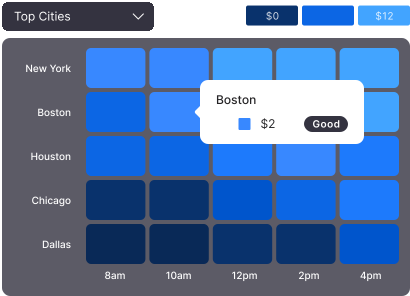
Advanced users gain confidence as the system confirms their intent. New users see the outcome of their choices as they build. Each step surfaces performance signals, turning abstract decisions into visible results.
Reflection
CREATING SIMPLICITY
Sometimes, the simplicity of the end-product feels like it undoes all the thinking you've done for its conception. And that's something I had to reckon with in this project.
I used to think that our work will always be representative of all the hurdles you've had to jump through to get to the final point, but I found it to be quite the opposite with this project. Because if I'm always working to show myself, to prove the process in the end result, then in a way that's selfish work.
In the end, my work isn't about proving myself; a trap I've found myself falling into quite often over the years, but about understanding that simplicity is just a distilled form of complexity.
This project has allowed me to loosen my grip on how controlling I am of the outcome, and to trust that the work will speak for itself. And that has felt quite liberating.